
Vietnamese Americans are widely recognized as the ethnic group with the largest presence in U.S. nail salon ownership. The Smithsonian’s National Museum of American History reports that more than half of U.S. nail salons are owned by Vietnamese Americans. However, estimates vary by source and year. An earlier UCLA study estimated that Vietnamese Americans owned about 30% of U.S. nail salons.
The safest conclusion is that Vietnamese Americans have the largest documented ownership presence in the American nail salon industry, although there is no single current government statistic giving an exact nationwide percentage.
Which Ethnic Group Owns the Most Nail Salons?
Vietnamese Americans are the group most strongly associated with nail salon ownership in the United States.
Other communities also have an important role in the industry, including:
- Korean Americans
- Chinese Americans
- Nepali Americans
- Tibetan Americans
- Filipino Americans
- Latinx immigrants and entrepreneurs
UCLA research describes the nail industry as heavily immigrant-owned and staffed, with Asian American and immigrant communities making up a substantial portion of the workforce.
What Percentage of Nail Salons Are Vietnamese-Owned?
There is no single universally accepted percentage.
A UCLA study estimated that about 30% of the roughly 22,000 U.S. nail salons were Vietnamese-owned, while the estimate in Los Angeles was around 80%. More recently, the Smithsonian has reported that more than half of U.S. nail salons are owned by Vietnamese Americans.
These figures can differ because the studies were conducted at different times and used different methods.
A simple answer is:
Vietnamese Americans are the largest ethnic group associated with U.S. nail salon ownership, with estimates ranging from about one-third to more than half depending on the source and year.
Why Are Vietnamese Americans So Prominent in Nail Salons?
The main explanation is historical, not biological.
Following the Vietnam War, many Vietnamese refugees came to the United States. California became a major center of Vietnamese American settlement, and manicuring offered an accessible path into employment and, eventually, business ownership.
Actress Tippi Hedren is often recognized for helping Vietnamese refugee women in California learn manicuring during the 1970s. This played an important role in the early development of Vietnamese participation in the industry.
Over time, the profession grew through:
- Vocational training
- Family connections
- Mentorship
- Community networks
- Word-of-mouth employment
- Entrepreneurship
These connections helped create a strong and lasting professional network.
How Did Family Networks Help?
Once someone learned how to become a nail technician, they could help relatives and friends learn about training, licensing, employment, customer service, salon management, and business ownership.
A technician could eventually open a salon and create opportunities for others. Over decades, this helped build a large Vietnamese American presence in the industry.
This type of professional networking is common in many immigrant communities and is not unique to Vietnamese Americans.
Why Did Nail Salons Become a Path to Business Ownership?
Nail services offered a relatively accessible route from employee to entrepreneur.
A technician could build a customer base, gain experience, save money, learn salon operations, and eventually start a business.
UCLA research found that 68% of nail salons in its data had fewer than five employees, showing how common small, independently owned salons are.
Is California Different?
Yes. California has an especially strong Vietnamese presence in the nail industry.
UCLA research has found a very high concentration of Vietnamese workers in California’s nail industry. The state’s large Vietnamese American population and its role in the early development of the industry help explain this.
However, the national industry is more diverse. Ownership patterns can differ significantly between California, New York, Texas, Illinois, Florida, and other states.
What About Korean-Owned Nail Salons?
Korean Americans have also played a major role in the U.S. nail industry, particularly in cities such as New York.
For that reason, it would be inaccurate to describe the American nail industry as exclusively Vietnamese. The industry includes many immigrant and Asian American communities, with Vietnamese Americans being one of the most prominent groups.
Are Vietnamese Nail Salons Usually Family Businesses?
Some are, but not all.
A Vietnamese-owned salon may employ technicians from Vietnamese, Korean, Chinese, Filipino, Latinx, or other backgrounds. Similarly, a Vietnamese technician may work in a salon owned by someone from another ethnicity.
Owner ethnicity and employee ethnicity are separate statistics.
Are Most Nail Technicians Vietnamese Too?
Vietnamese Americans are also heavily represented among nail technicians.
UCLA research found that the U.S. nail workforce was predominantly Asian and included Vietnamese, Korean, Chinese, Nepali, Tibetan, and Latinx workers.
The Smithsonian has also reported that more than half of the nail salon workforce is Vietnamese.
However, workforce figures should not be confused with ownership statistics.
Does Vietnamese Ownership Mean Vietnamese People Are Naturally Better at Nails?
No.
There is no good reason to believe that ethnicity makes someone naturally better at manicures or nail art.
A more reasonable explanation is:
History → opportunity → training → experience → community networks → entrepreneurship.
When a community has participated in an occupation for decades, professional skills and business knowledge can be passed from experienced workers to newcomers.
What Services Do Vietnamese-Owned Nail Salons Offer?
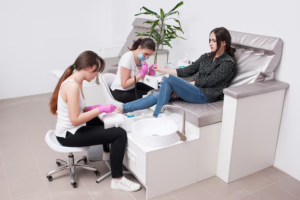
Vietnamese-owned nail salons offer many of the same services found in other salons, including:
- Manicures and pedicures
- Gel manicures
- Acrylic nails
- Gel extensions
- Builder gel
- Dip powder
- French manicures
- Nail art
- Chrome designs
- Custom designs
- Spa pedicures
Services vary by salon and technician.
How Has the Nail Industry Changed?
The nail industry has changed significantly over the years. Modern salons may offer specialized nail art, advanced extensions, builder gels, dip systems, LED curing, online booking, and digital payments.
Customers can now choose from a much wider variety of styles and treatments than in earlier decades.
What Should You Consider When Choosing a Nail Salon?
When searching for nail salons near me, don’t choose based only on the owner’s ethnicity.
Check Cleanliness
Look for clean work areas and good sanitation practices.
Read Recent Reviews
Look for feedback about quality, cleanliness, customer service, and attention to detail.
Check Services
Make sure the salon provides the manicure, pedicure, extensions, or nail art you want.
Ask About Pricing
Confirm the price before adding custom designs, extensions, or other upgrades.
Consider Technician Experience
Skill, training, experience, and professionalism are more useful indicators of quality than ethnicity.
Frequently Asked Questions
What ethnicity owns the most nail salons?
Vietnamese Americans are widely reported as the ethnic group with the largest presence in U.S. nail salon ownership. Estimates vary, with sources reporting figures from about 30% to more than half.
What percentage of nail salons are Vietnamese-owned?
There is no single definitive current percentage. UCLA previously estimated about 30% nationally, while the Smithsonian has reported more than half.
Why do Vietnamese Americans own so many nail salons?
Their strong presence developed through Vietnamese immigration, vocational opportunities, training, family networks, community support, and entrepreneurship.
Are Korean Americans also major nail salon owners?
Yes. Korean Americans have historically had a significant role in the industry, especially in major metropolitan areas.
Are Vietnamese-owned nail salons better?
Not automatically. Quality depends on the individual technician, training, sanitation, products, customer service, and business practices.
Are most nail salons immigrant-owned?
Research indicates that a large majority of U.S. nail salons are small, immigrant-owned businesses.
Conclusion
Vietnamese Americans are the ethnic group most strongly associated with nail salon ownership in the United States. Although estimates differ between studies, the research consistently shows a particularly strong Vietnamese presence.
This prominence developed through immigration, training, community networks, and entrepreneurship rather than any natural advantage based on ethnicity. California played an important role, but Vietnamese-owned nail salons are now found throughout the country.
When choosing a salon, focus on cleanliness, technician skill, experience, reviews, services, pricing, and customer care.
If you’re searching for nail salons near me, nail salons in Naperville, or nail salons open near me, Naperville Nail Spa provides professional nail care in Naperville, including manicures, pedicures, and other nail services. Call (331) 701-7925 to learn more or schedule an appointment.
